Monday, 30 April 2007
Dare to dream!
Casting our scepticism about the near-term future aside, please feel free to share your dreams of what kind of Israel and Palestine you would like to see in the more distant peaceful future.


Still to come...
My trip is almost at an end but the writing isn't. Travelling around and writing so much has proven quite a daunting challenge. There are still some encounters which I haven't written up yet, but I will do so in the coming days. In addition, 'Without a road map' will not end with my departure, as I intend to pursue further and develop certain avenues - both intellectual and practical - which have arisen during my trip. I also intend to return - next time with my wife - to talk to more people, see the things I missed out this time and hopefully provide a tiny ray of hope and inspiration. So, don't forget to subscribe to this blog to receive information on future updates.
I have decided to take a break from writing today to recharge my batteries a little. But still to come:
* Conversation with Uri Avnery, Israel's leading peacemonger
* Tea at the Resistance Cafe in Hebron (featuring hardcore settlers)
* Verbal pub brawls and raising the bar by propping it up
* Is a two-state solution still feasible?
* Al Haq and human rights in the Palestinian territories
* Reflections on Israeli society
* Lessons learnt from the 'Without a road map' tour
I'd like to thank everyone who has been following my daily encounters and musings. It really helped spur me on. Wish me luck on the way out. Apparently, I can look forward to questioning at the airport.
I have decided to take a break from writing today to recharge my batteries a little. But still to come:
* Conversation with Uri Avnery, Israel's leading peacemonger
* Tea at the Resistance Cafe in Hebron (featuring hardcore settlers)
* Verbal pub brawls and raising the bar by propping it up
* Is a two-state solution still feasible?
* Al Haq and human rights in the Palestinian territories
* Reflections on Israeli society
* Lessons learnt from the 'Without a road map' tour
I'd like to thank everyone who has been following my daily encounters and musings. It really helped spur me on. Wish me luck on the way out. Apparently, I can look forward to questioning at the airport.
Sunday, 29 April 2007
Tuning into peace in stereo

By Khaled Diab
All for Peace is the only joint Palestinian-Israeli radio station around. This unique media voice is 50% Israeli and 50% Palestinian. Likewise, the content is also balanced equally, and the gender mix is finely tuned.
"Our main objective is to disseminate information that does not fall within the agendas of both people's media - which are, on the whole, too nationalistic," Faris Arouri, the station's public and international relations coordinator, told me. "We seek to spread accurate information about life on the other side because there are a lot of misconceptions, particularly on the Israeli side, because they are the dominant power."
The most troubling misconception on both side, as Faris puts it, is that "the Israelis fear we want to drive them into the sea; we fear they want to drive us across the Jordan". But minefields of misperceptions in terms of culture, society and religion litter the chasm between the two peoples.
The station, which goes out in 107.2 fm, has seen its mission evolve from directly striving for peace to building the solid ground on which it can take root. "At first, it was about convincing people of the need for peace. Now it's about giving hope. We always endeavour to give unbiased coverage."
Civil society, which does good work but is often overlooked by the mainstream media, has pride of place at All for Peace.
The station has been a success, attracting some 40,000 simultaneous listeners at peak moments, and a total of around 100,000 listeners per day.
One of All for Peace's most spectacular scoops was a conversation it broadcast between Noam Shalit, the father of the abducted Israeli soldier in Gaza, Gilad, and the Popular Resistance Committees Spokesman Abu Mujahad.
"After their conversations, each side said that only dialogue and prisoner exchange would secure Gilad's release. The father even said that if Israel attacked Gaza to try to rescue his son and his son died, he would hold his government responsibile for Gilad's death," noted Faris.
But the station's greatest achievement, according to Faris, are not spectacular scoops but the gradual demystification of the other side. "The biggest success of the station is that it gives people on both sides the chance to humanise one another, instead of focusing only on the suffering and agony."
©Khaled Diab. Text and photos
Guns and wreaths and the face that failed to launch a nation

By Khaled Diab
On a twilight stroll through the still rather deserted town, everyone we came across was incredibly friendly, warm and welcoming, striking up conversations as we walked past and the children asking me to take photos of them. Our 'outlandish' appearance and my accent meant that our progress through the streets was rather slow at times, as we stopped to chat and press the flesh.
Ramallah today has grown to merge with a neighbouring village. Once it was little more than a village itself, but the 1948 refugees made its population swell. It is surrounded on just about every visible hilltop by settlements, some of which are so close to Palestinian homes that all that separates them is a thin brick wall or they can actually see each other through the windows. This leaves very little wiggle room for the increasingly crowded town to expand and the locals told me this makes them feel trapped, surrounded from all sides by Israel.
The closures, restrictions on movement, the difficult economic situation and the encroaching settlements have led to a gradual depopulation of the area, according to one local I met. Usually, the ones who can leave are the more educated and cosmopolitan, and that is one reason why the Christian population in Palestine has dropped significantly.
A little out of the old town, we heard a series of loud gunshots. A little further up the road, a couple of men were emptying out their guns into the open air to express their grief at the death of their fallen comrade whose wake had just taken place in a nearby building. "There goes a week's wages," Tom observed, having earlier explained to me how expensive bullets were because they were often purchased on the black market.
When I pointed my camera at the two men with the guns, their colleagues who were standing behind us tsk-tsked and told us to stop, and not to shoot. Not really in the habit of defying (or even being near) men with smoking guns, I lowered my camera carefully as if it were a weapon.
The Egypt card had served me well so far, so I tried to reassure them by saying: "Don't worry, I'm Egyptian - I just want to take a photo."
To my utter surprise, the demenure burly man who had just been communicating to me with steely coolness softened dramatically and he became all welcoming. "Go ahead and take your photo," he said in the same sort of voice as an Arab offers tea to his guests. To help faciliate my task, he called out across the street to the men with the guns telling them to fire their guns for the Egyptian. One of them was grumpy and unco-operative - probably didn't like doing tricks for strangers - but the other one was only to happy to oblige. Unfortunately, his gun kept jamming or a car would pass in front of the camera, so it took a few attempts and the result still wasn't perfect.
Following the fireworks display, we walked around the posher part of town. Ramallah has a fair amount of ostentatious wealth floating about, judging by the fancy houses and flash cars about. The Edward Said Conservatory, Tom told me, has built up quite a reputation and graduates talented musicians. Israeli conductor and pianist Daniel Barenboim still comes to perform there at least once a year, infuriating the Israeli right.
The city has a few gaping craters where buildings were demolished by the Israelis, such as when they destroyed a police station after the lynching of a couple of their soldiers on a mission. Many of the walls and shop fronts bear posters of some of the thousands of political detainees being held by Israel.
We went to the 'Muqata'a', which had variously been a British camp, an Israeli prison, the PA's nerve centre, and became an Israeli prison again when Arafat and a group of his dedicated supporters were besieged there. It's interesting that both sides have their own conspiracy theories about his death: some Palestinians think the Israelis found a way of poisioning him and some Israelis believe he died of AIDS and was a closet homosexual.
Rebuilding work was well advanced and a lot of the destruction that Israel had wrought on this symbol of Palestinian weakness, hopelessness and fortitude. A small mausoleum is almost complete for the face that tried, but failed, to launch a nation.
©Khaled Diab. Text and photos
The refreshing taste of revolution in Ramallah

By Khaled Diab
On Friday morning, I set off to Ramallah. While I was waiting for the bus driver to return from Friday prayers, a group of young lads hit off a conversation with me.
They had got to Jerusalem by jumping out of the minibus just before the check point and taking back routes. On the journey back, there would be no problem because the Israeli military didn't really care who entered Ramallah.
Like so many other Palestinians I have come across, these younguns informed me eagerly that they loved Egypt and Egyptians - believing the celluloid myth that we are all friendly, kind-hearted, care for others and have a wicked and biting sense of humour.
In fact, travelling around this land has made me somewhat self-conscious because I seem to draw attention as if I were some kind of minor celebrity - nothing major, just someone who features in a crappy soap opera about a bitter, generations-old feud between two families: a rich and powerful one and its poor cousin.
The boys who worked at a shopping mall in Ramallah joked with me about their dead-end lives, smoking, Egypt and wanting to get out of Palestine. "Take me to Europe with you. Everything here is so messed up - the occupation is humiliating and the PA are pimps!" one of them maintained.
A do-good busy-body type standing near by decided to give them his Shekel/Dinar's worth. "How are we ever going to build a country, if every young person wants to get out and is going to bad mouth it?" he asked, although he was not actually interested in a reply.
I could not really blame the young men for wanting to flee the misery and madness around them - who wouldn't? In most of the Occupied Territories, if I recall the stats correctly, unemployment is running at over 50%, the majority of the population lives under or near the poverty line and they can barely move from one town to the next without an Israeli permit.
Just before I got on the bus, I got a message from Tom, my Belgian friend who lives and works in Ramallah for a Palestinian NGO, informing me that there had been a gun battle the previous night and the city was not only quiet because it was Friday but was also dead because of a curfew on shops and businesses.
When I arrived, Tom led me through Ramallah's semi-deserted streets. Most of the shops were shut, or had their shutters down but were working surreptitiously behind doors left ajar for their customers. The so-called 'strike' was apparently by order of the Al Aqsa Martyrs Brigade. Tom suggested that we sit out the strike in his favourite cafe. En route, we chatted about his work and life in Ramallah.
Inside the cafe, we met a group of his NGO friends, such as Gareth, an Irish lawyer with Al Haq, a Palestinian human rights organisation, and Emma, a Palestinian-Brit with Save the Children.
First bottle up against the wall
With the cafes shutters down, it felt like we were in a kind of American prohibition and clandestinely drinking a toast to the revolution of Palestine's best beer. Al Taybeh, whose slogan is 'taste the revolution', is a quality local poison and a successful Palestinian export.
When I told one of the punters that many Israelis find it hard to believe that Palestinians drink alcohol, he retorted: "They'd better believe it. Israeli beer is so bad that even Israelis don't drink it. Our is good enough for us and good enough for export."
He said that the Israelis lived a few kilometres up the road yet they knew very little about the realities of Palestinian society. To him, this was proof of a willful ignorance - he believed Israelis would rather not know because that makes living with the occupation easier.
We sat around discussing Israeli abuses of human rights, the security wall, Tom's theory that an Egyptian pyramid could not have been possibly built in 20 years (at which point, we all got out our phone calculators to disprove him). Gareth provided us with access to his on-brain log of weird legal precedents under eccentric English common law.
The cafe's colourful Palestinian owner gave me his political punditry on everything from the Sykes-Picot agreement to the wall in Israel and now in Iraq. "Who are the Israelis trying to kid?" he asked eagerly, his eyes blazing with excitement. "The man who shot the policeman yesterday was a car smuggler. If criminals can get around the wall, do the Israelis really think it will keep out a determined killer? The wall is about land, not security."
©Khaled Diab. Text and photos.
A chain of peaceful voices

By Khaled Diab
East Jerusalem’s Ambassador Hotel is a favourite gathering point for civil society and that is where I was due to meet with representatives of the fledgling umbrella alliance of Palestinian and Israeli peace NGOs.
The Palestinian-Israeli Peace NGO Forum does what the label says: it brings together over 100 Israeli and Palestinian civil society organisations striving, either directly or indirectly, for peace. Its name might be a bit of a mouth full and may need to be reinforced with a media-genic and shorter alternative, but its mission is an important one.
Nancy Sadiq of the Palestinian Centre for the Dissemination of Democracy (Panorama) and Yael Patir of the Peres Centre for Peace are in charge of the day-to-day coordination of the initiative. Traffic is a problem in some megalopolises but this part of the world has its own unique mobility problems.
Nancy and her colleague, who work and live in Ramallah, were delayed for around an hour longer than expected at a checkpoint for reasons unbeknown to them. Nancy has a special longer-term pass that allows her to make the 15-km journey to Ramallah. Her colleague is not so fortunate and was only issued a two-day pass.
While we were waiting, Yael filled me in on the purpose and activities of the forum which was officially established in January 2006 after a long process of negotiations between its various member institutes.
“The idea of the forum is to bring together civil society from both sides to build understanding,” she explained to me. “We also want to join our voices together to make sure we’re heard.”
The forum pursues a bottom-up approach to peace-building and focuses more on the socio-economic aspects than. "We are a coalition that is targeted more at the grassroots. We try to minimise political activism."
The initiative received funding fromp the European Union for its first two years. "We don't see this as a temporary project but something that is here to stay," she explains. "But funding will be a major challenge."
The forum's activities to date have included written support for the Arab peace initiative. "We issued a joint statement supporting [it] which we sent with Abu Mazen [aka Mahmoud Abbas] to the Arab League summit. We also published an advertisement in the paper." They also issued a joint statement in support of non-violence, Nancy explains when she finally manages to join us.
The platform does not plan any major activities for the 40th anniversary of the Israeli occupation of the West Bank and Gaza, because many of its member organisations are already planning large events. Instead, it will provide them with support.
This year also marks the 20th anniversary of the first intifada. "On the Palestinian side, we are discussing the possibility of organising events to mark this date focusing on the non-violent aspect of that conflict," describes Nancy.
©Khaled Diab. Text and photos.
Friday, 27 April 2007
Strolls of faith for the faith challenged


By Khaled Diab
In Jerusalem, within the space of a few hundred metres, you can stroll between the holiest sites of the three monotheistic religions - in a kind of short-distance leap of faith!
A couple of friends have referred to my trip as a 'political pilgrimage'. And pilgrim was how I felt negotiating the narrow streets of Jerusalem.
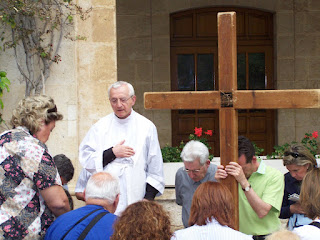
Without prior warning, my path crossed that of Christ. You can say I found Jesus... And his location was the second station of the cross - where Jesus actually picks up the cross - on the Via Dolorosa (The Way of Grief) - that route so gruesomly depicted by Mel Gibson in his controversial and fundamentalist The passion of the Christ. Inside a Franciscan church built on the supposed spot, a group of melancholic pilgrims sang hymns and a priest said something in Latin, before a Jesus stand-in lifted the cross on to his shoulder and carried it into the chapel with the faithful following him grimly.
On hallowed ground
A couple of hundred metres along, I saw the golden-coloured Dome of the Rock rise above the buildings. For Muslims, the Al Aqsa Mosque is not only the first qibla towards which the earliest Muslims prayed before it was switched to Mecca, it is also a potent symbol of the Palestinian struggle.
Entering the complex required a rite of passage, you could say. At the gate was a Palestinian policeman and two Israeli soldiers. I realised immediately by the way they looked at me that I had not chosen the most appropriate clothes for the occasion - long shorts and a fireman's shirt! The Palestinian policeman asked me if I was Muslim. I told him that I was. He asked me my full name and, as it had a Mohamed in it, that was the first proof of concept.
Then he asked my nationality, so I told him I had dual Belgian-Egyptian nationality and I handed him my passport which he handed to the Israeli guards who started flicking through in search of my stamp.
The policeman asked me if I intended to pray inside. I said that I intended to look around and might return the following day for Friday prayers, whereupon he set me a surprise quiz. He asked me how many raqaa's there were in each of the five daily prayers. Being faith challenged and having not prayed for years, I confused one of the prayers - which caused him to look sideways at me with suspicion. "Look, I'm not very religious, okay?" I said to him. I remembered the comment of the older Palestinian man I'd met earlier who told me that when he was young people of different faiths would visit each other's places of worship.
The Israeli soldiers did not know that you could enter the country without a stamp on your passport and were also suspicious at first and radioed to ask their superior. One of them saw the Ethiopian visa in my passport and asked me if I had been to "E-tee-oh-piya". Seeing from his face that he was of Felasha descent, I said I had and asked him if he was Ethiopian. He proudly informed his comrade that I had been to his great country - a description which didn't seem to impress the other soldier - and proclaimed confidently about me: "He's a good man!"
Inside the complex, I was enawed, although I suppose some more faithful soul might think that the opportunity was somewhat wasted on me. That's not to say I didn't feel anything spiritual. No one can be among so much history and symbolism- both above and below the ground - without feeling a sense of humility.
Many of the faithful inside the complex gave me funny looks because of my clothes and I had apparently become something of a celebrity among the security dotted around the grounds. "Are you the Egyptian?" I was asked several times.
One disapproving stiff came up to me and held me by the elbow. "Tell me brother, why are you wearing that? You are inside a holy area, you know."
"What's wrong with it?" I returned. "My shorts are shari'e (legit according to Islamic principles)." Having no adequate response, he turned away without another word and marched purposefully off.
The compound was much larger than I had ever imagined. When you hear about the politicised nature of the Al Aqsa Mosque, you hardly expect the tranquility you encounter inside and all the families sitting around enjoying picnics and the children playing football. One little three-year-old girl decided that I was her friend and took me over to meet her parents after I took a photo of her. I chatted with them for a while. The father told his daughter that I came from the country of Ehab Tawfiq and Amr Diab. I asked him if she could sing any songs. He said that she couldn't as she was only three but she had learnt some of the Quran. She recited the Fatiha with all the rolled 'r's turned into 'l's.
Under the Temple Mount is the Western Wall, the most sacred site for Jews. After another longer security check, I entered. It's not quite as spectacular as I imagine the second temple which stood on the site until it was destroyed by the Romans was. Modest or not, the Jews there stared at the wall with intense reverence, with the orthodox ones unwilling to take their eyes of it or show disrespect so they walked blindly backwards.
It felt surreal to be among all the bizarre fashion sense of the Hessidic and other orthodox Jews. There are the curls, the string which dangles around their trousers, apparently because God ordered Moses to do so, and the piece de resistance, the weird miner's lamp contraption they wear on their heads. This apparently symbolises the way that Moses was unable to look directly at God's aura. The swaying backwards and forwards while reciting scripture reminded me a lot of young Muslim children who go to the kutab (Quranic school).
©Khaled Diab. Text and images.
Subscribe to:
Posts (Atom)

