By Khaled Diab
Going out for a drink is great in and of itself. But boozing for a good cause is a wonderful cocktail of sin and virtue! In fact, I, for one, am willing to pub crawl all the way along the road to peace.
While in Jerusalem, I went out with The Guardian's ‘Comment is Free’ contributors Seth Freedman and Alex Stein. Seth even wrote this article about the encounter. And I've been berated by Alex for not replying to it yet. "Not good enough for yer, were we?" he quizzed in his booming voice.
In his column entitled 'Long live lunacy', Seth described our encounter so:
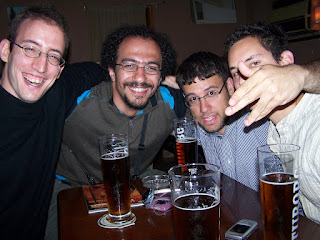
In a crowded bar in downtown Jerusalem, Khaled joined our crew for a night of heavy drinking and even heavier debate.
What began as a getting-to-know-you exercise soon descended (or ascended, depending on your interpretation) into a heated debate about last summer's war in Lebanon. In the blue corner was Khaled, the Egyptian born Muslim; in the red corner was Max, a boy I grew up with in London and who took part in the ground offensives inside Lebanese territory last year.
While in Jerusalem, I went out with The Guardian's ‘Comment is Free’ contributors Seth Freedman and Alex Stein. Seth even wrote this article about the encounter. And I've been berated by Alex for not replying to it yet. "Not good enough for yer, were we?" he quizzed in his booming voice.
In his column entitled 'Long live lunacy', Seth described our encounter so:
In a crowded bar in downtown Jerusalem, Khaled joined our crew for a night of heavy drinking and even heavier debate.
What began as a getting-to-know-you exercise soon descended (or ascended, depending on your interpretation) into a heated debate about last summer's war in Lebanon. In the blue corner was Khaled, the Egyptian born Muslim; in the red corner was Max, a boy I grew up with in London and who took part in the ground offensives inside Lebanese territory last year.
Max Terminator, as I was soon to start calling him, describes himself as “hardly a pacifist”. Being a strident, and sometimes aggressive pacifist myself, his Rambo approach to life was guaranteed to provoke me. Our verbal pub brawl did little to bridge our differences of opinion over the Lebanon war – which I perceive as a complete failure no matter how you look at it – but Max and I did discover that we shared some surprisingly similar views about the future, particularly regarding the possible emergence of a federal Israeli-Palestinian state.
One striking thing about our little get-together was the amount of common culture we shared – around the table, there were four Jewish ‘London boys’ and an Egyptian one. And I think the mixing and matching of the global melting pot offers some hope for the future by eroding perceived cultural differences even further. For instance, Alex, who was about to join the IDF, was my cavalry against Max Terminator’s sound offensive.
Although the decision of all these young Londoners to volunteer to join the IDF raises certain moral issues in my mind, I do not doubt their moral rectitude as individuals and I respect Alex and Seth’s attempts to be fair in their judgements and reach out to the other side.
Encounters, both virtual and in the flesh, are crucial to bridging gaps and breaking down misunderstandings and misconceptions. This was illustrated eloquently by our eagerness for a second encounter which I had with Alex and Max in Tel Aviv – where we were also joined by a couple of Haaretz guys and an American couple – and where the debate was less like a pub brawl and more like a debating society.
And we have more opportunities than ever before to do so.
As Seth put it:
And then comes Khaled – a man so keen to dive into the maelstrom that he flies across the world to meet the people on the street, such as my friends and me… and the more encounters like this… the closer we'll come to bridging the chasm and reaching solutions.
As I noted in an earlier post, Palestinians brew a very good micro-brewery beer. Israelis are not allowed into the Palestinian Territories and Palestinians need a permit to enter Israel. Why not set up impromptu tents at the checkpoints where Israelis and Palestinians can knock back a couple of pints for peace. I know a lot of people on both sides don’t drink. They can go for the alcohol-free version and chat over coffee or share a peace water pipe.
©Khaled Diab. Text and images.


