Showing posts with label peace. Show all posts

Tuesday, 8 May 2007

Blessed are the peacemongers

By Khaled Diab

Ever since I was introduced to the term ‘peacemonger’ in an article from September last year written by Uri Avnery, Israel’s most famous peacenik, I have quite fancied myself as one of those troublemakers beating courageously on my peace drum.

“A terrible enemy is conspiring to impose peace on us. He is advancing against us from two sides, in a giant pincer movement,” he wrote. “Against this danger of the Arab peacemongers, the Olmert government is calling up all its forces.”

But this official peace cavalry has been cut off at the pass and lacking the ability to win ‘hearts and minds’, it has retreated in silent defeat. That is why individual ‘peacemongers’ and dedicated bands of peace worriers must take up the fight. Lightly armed with compassion, empathy, wit, guile and a willingness to compromise and coexist, they must launch their own stealthy guerrilla offensives against the massed forces of hatred and distrust mobilised by the extremists.

Given my powerful desire to declare peace on the enemy, I decided that it was a good idea to visit Uri Avnery, Israel’s best-known and most controversial ‘peacelord’ to exchange strategies and debate ideas. Having read so much of his writing over the years, the idea of meeting him did fill me with a certain amount of trepidation. This wise old man was once a teenage member of the extremist Jewish militia, the Irgun – branded the ‘terrorists’ of their time.

His colourful career has seen him reinvent himself to become Israel’s leading alternative media publisher in the 1950s and 1960s, one of its most radical politicians and eventual founder of Gush Shalom, the left-wing peace movement. He was the first Israeli to meet Yasser Arafat, during the Battle of Beirut in 1982, and faced accusations of being a ‘traitor’ from fellow Knesset members.

Over the years, Avnery has been Israel’s loud and unrelenting public conscience. Although never part of the Israeli mainstream, the veteran peacenik has had a massive magnifying effect over the years, often occupying a pioneering position that the mainstream would later flow towards – what he calls, the ‘small wheel effect’. As I also suffer from the urge to roam uncharted yet fertile political and social terrain, I thought it would be useful to meet a veteran ‘pioneer’.

Given his visionary’s ability to look beyond the here and, I wanted to hear from him what kind of wheels are currently being set in motion and what the future holds.

Prophet of peace
On my last Sunday in Israel, Uri Avnery ushered me into his Tel Aviv apartment which boasted one incredible view. His brilliant white beard and hair had a faint suggestion of the Biblical prophet about it. He sat me on armchair where I could admire the setting sun as it descended into the Mediterranean. Behind my shoulder was the sky-fawning Tel Aviv skyline.

In his no nonsense and slightly intimidating manner, he got straight down to business: “What is it exactly you wish to talk to me about?”

I asked him what settlement he expected. “The solution is that there will be a Palestinian state in the Occupied Territories along the Green Line, with some small exchanges of territory. And Jerusalem will be under joint control,” he predicted.

I asked him how this would come about, given that the Israeli government had turned down the Arab League’s peace overtures – and the other sticking points, such as the status of Jerusalem and the right of Palestinian return.

“There must be push and there must be pull. It is good that the Arab League is offering clearly and unequivocally a fair peace offer. The push must come internally from the peace movement and from the international community.”

I wondered to myself how likely it would be that the peace movement would be able to mobilise enough support in time to salvage this latest bid and whether the international community would be able to take a robust stand, given America’s own stridently militaristic approach in the region and Europe’s inability to agree on a common Middle Eastern policy.

I asked him about the prospect of moving the 400,000 settlers living in the West Bank – or at least most of them – given how difficult it was to pull only 8,000 settlers out of Gaza. “It’s difficult,” he admitted. “But it won’t get any easier. An exchange of territory may partly solve this, but there’s no way to avoid it.”

He went on to explain that: “The Israeli government does not want peace because of the political price of dismantling the settlements. In general, Israeli society does not like the settlers. But they are Israelis, so it is a difficult challenge to face up to.”

“If you want peace, you must remove settlements,” he stressed.

I told him about the remarks I’d heard from numerous Israelis who expressed a fear that if they abandoned the West Bank, the Palestinians would just see it as an opportunity to launch more rocket attacks. “Either you have peace or you don’t have peace. You can’t say ‘I don’t want peace because I’m afraid of war’.” He warned that if no peaceful settlement was reached soon, “the West Bank would be like Gaza in a couple of years.”

When I asked what he thought of Israel’s so-called ‘deterrent posture’, he said he believed it was counterproductive and had to be abandoned but explained that it was a product of the hostility Israel has historically faced in the region, as well as the collective trauma of the Holocaust, after which Jews vowed they would never be so weak again.

Reaching across the divide
I asked Avnery what the Palestinians could do to better manage their cause. He recommended that Palestinian activists should work on creating real co-operation with the peace movement in Israel. “After the death of Arafat, all connections were cut. Now, the need to reach out to Israeli society,” he said.

They also need to work on constructing a unified Palestinian voice and highly organised social structures. “They need social organisations that allow Palestinian resistance to become general and non-violent… Mass action in the spirit of Martin Luther King is very effective, but need strong organisation.”

“Violent resistance has proved ineffective… Non-violence for me is not a question of principle; it is a question of usefulness,” he added.

He then turned his attention to the wider region. “In all this, the Arab World has not played a very glorious role. They have done very little to help the Palestinians. Even today, it is ridiculous that the West can impose an embargo on the PA and the Arabs, like Saudi Arabia, cannot keep the Palestinian struggle alive with their oil wealth.”

I asked him about the prospects of a bi-national federation emerging sometime in the future. “Any independent Israel and Palestine would have very close ties. There can be no truly separate states because the country is too small and their economies are interdependent.”

Whether they simply coordinated everything closely or formalised their relationship in the form of a federal arrangement would depend on the political climate of the time. “Our two peoples are much closer to each other than would appear in the clouds of conflict. What prevents closer co-operation and ties is the occupation.”

He used Belgium as a useful analogy for Israel-Palestine, with two communities, Flanders and Wallonia, and Brussels like Jerusalem. He said that Arafat often spoke of BeNeLux between Israel, Palestine and Jordan. He also said that King Hassan of Morocco had told him that he had proposed in the 1950s that Israel be invited to join the Arab League.

“At least for the foreseeable future, I see the two states as the only sensible solution,” he noted.
I asked him how optimistic he was about the future. He told me that he expected peace in his lifetime. The man is a robust and healthy 83.

©Khaled Diab. All rights reserved.

Thursday, 3 May 2007

Pints for peace


By Khaled Diab

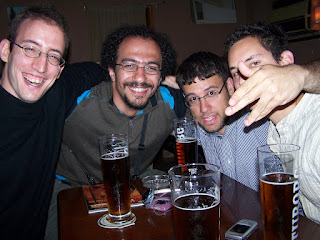
Going out for a drink is great in and of itself. But boozing for a good cause is a wonderful cocktail of sin and virtue! In fact, I, for one, am willing to pub crawl all the way along the road to peace.

While in Jerusalem, I went out with The Guardian's ‘Comment is Free’ contributors Seth Freedman and Alex Stein. Seth even wrote this article about the encounter. And I've been berated by Alex for not replying to it yet. "Not good enough for yer, were we?" he quizzed in his booming voice.

In his column entitled 'Long live lunacy', Seth described our encounter so:

In a crowded bar in downtown Jerusalem, Khaled joined our crew for a night of heavy drinking and even heavier debate.
What began as a getting-to-know-you exercise soon descended (or ascended, depending on your interpretation) into a heated debate about last summer's war in Lebanon. In the blue corner was Khaled, the Egyptian born Muslim; in the red corner was Max, a boy I grew up with in London and who took part in the ground offensives inside Lebanese territory last year.
Max Terminator, as I was soon to start calling him, describes himself as “hardly a pacifist”. Being a strident, and sometimes aggressive pacifist myself, his Rambo approach to life was guaranteed to provoke me. Our verbal pub brawl did little to bridge our differences of opinion over the Lebanon war – which I perceive as a complete failure no matter how you look at it – but Max and I did discover that we shared some surprisingly similar views about the future, particularly regarding the possible emergence of a federal Israeli-Palestinian state.

One striking thing about our little get-together was the amount of common culture we shared – around the table, there were four Jewish ‘London boys’ and an Egyptian one. And I think the mixing and matching of the global melting pot offers some hope for the future by eroding perceived cultural differences even further. For instance, Alex, who was about to join the IDF, was my cavalry against Max Terminator’s sound offensive.

Although the decision of all these young Londoners to volunteer to join the IDF raises certain moral issues in my mind, I do not doubt their moral rectitude as individuals and I respect Alex and Seth’s attempts to be fair in their judgements and reach out to the other side.

Encounters, both virtual and in the flesh, are crucial to bridging gaps and breaking down misunderstandings and misconceptions. This was illustrated eloquently by our eagerness for a second encounter which I had with Alex and Max in Tel Aviv – where we were also joined by a couple of Haaretz guys and an American couple – and where the debate was less like a pub brawl and more like a debating society.

And we have more opportunities than ever before to do so.

As Seth put it:
And then comes Khaled – a man so keen to dive into the maelstrom that he flies across the world to meet the people on the street, such as my friends and me… and the more encounters like this… the closer we'll come to bridging the chasm and reaching solutions.

As I noted in an earlier post, Palestinians brew a very good micro-brewery beer. Israelis are not allowed into the Palestinian Territories and Palestinians need a permit to enter Israel. Why not set up impromptu tents at the checkpoints where Israelis and Palestinians can knock back a couple of pints for peace. I know a lot of people on both sides don’t drink. They can go for the alcohol-free version and chat over coffee or share a peace water pipe.
©Khaled Diab. Text and images.

Wednesday, 25 April 2007

Stuck in the wilderness

For years, everyone has been asking: “Where did peace go?”

Well, I think I have been able to locate that elusive creature – but he is not in the best of shape. At this very moment, Shalom/Salaam is stuck at the border, insisting that he is not carrying a bomb.

“Are you carrying a weapon?” a string of Israeli officers ask him.

“Bro, I come in peace,” replies Peace, with his long, centre-parted hippy hair and Jesus creepers.

“But can you guarantee that you will stay in peace?”

“Just sign a peace deal and you will see the difference.”

“But can you guarantee that the Qassam rockets will stop? If we pull out of the West Bank, might the Palestinians not want more and use violence to try to get it. Israel is such a small country – at some points it is less than 10km wide. It is vulnerable to these rocket attacks.”

“Of course, Israel has the right to live in peace,” Shalom/Salaam maintains. “But even Hamas, because its charter does not recognise Israel’s right to exist, has indicated that it would accept a Palestinian state on the pre-1967 border. Besides, the Arabs have offered you a comprehensive peace deal and Syria wants to negotiate. What are you waiting for?”

“But it is impossible for us to evacuate the 400,000 people living in the biggest West Bank settlements. The political price inside Israel would be too high.”

“Why didn’t you think of that before you built them on occupied land.”

“At first, we wanted to use them as bargaining chips in negotiations with the Arabs. But, in Khartoum, in 1967, the Arabs issued their famous three ‘No’s. After that, the extremists hijacked the settlement process and built thousands of homes on the seized land.”

“But Peace comes at a price, you know,” Salaam/Shalom says, hiding, behind a melancholic smile, his feeling of being undervalued and unappreciated all these years he’s been living in exile, out in the cold. “I’m not cheap you know.”

“We can give them an equivalent amount of land in the Negev or southern Israel.”

“So, you want to give them desert in return for fertile land?”

“Water is not an issue. We can supply them with water to meet all their needs.”

……
Many Israelis, even my open-minded hosts, seem to be under the conviction, to varying degrees, that there is no clear end in sight, that whatever Israel does will not be enough, that as soon as Israel pulls out of the West Bank, rockets will rain down on its head every day.

©Khaled Diab

Monday, 23 April 2007

Peace begins at school and at home


Khaled Diab

After visiting the elders, we went to a nearby town to meet some of the area's youngest citizens. We visited a joint Jewish-Arab school which Tzachi and Anat were considering sending their children to. The school's head teachers, Yochanan Eschschar and Noha el-Khatieb, kindly gave us a tour of their experimental establishment.

The school is still a young one, with only 200 kindergarten and primary school pupils, half of whom are Jewish and the other half Arab. Each bilingual class has two teachers, one Jew and one Arab, and the lessons are conducted in both Arabic and Hebrew. It being Memorial Day, the children were encouraged to work on activities and project in which they learnt about each side's pain and suffering, particularly with Independence Day around the corner for Israel, which is regarded as the nakba (Catastrophe) by Palestinians.

"We handle this sensitive subject by accepting the idea that there are two narratives, both of which are valid to their people. And we encourage both sides to be aware of the other's pain," Noha explained. "We want to encourage these children to set off together into the future," Yochanan continued.

But with only a handful of cash-strapped schools like this across the country, the difficulty of attracting Jewish children (who have so many options and whose parents fear Palestinian-Israelis) to study with Arabs, enlightened education like this will have little impact, despite its potential. "It's a drop in the ocean," Amos kept repeating sadly.

Hopeful conversations
In the evening, Amos and Tzachi decided to launch an oil-fuelled kite which took off and travelled for kilometres, with father and son chasing after it like maniacs afraid it would land somewhere and start a fire. Luckily, it touched down somewhere safely.

During dinner, the air-raid siren which goes off to inform Israelis that Memorial Day has begun went off and everyone stood up to stand silently for two minutes in private contemplation. I used the moments to reflect on my unusual day and the fact that I was here in Israel during its most intensely emotional time.

Before, during and after dinner a diwan­-style or round table debate started up between me and several generations of Israelis – my hosts, Anat's father, a recent arrival from America, an immigrant from Colombia and a young Israeli couple at university. It was incredibly constructive, informative and entertaining for all involved and we all came away with the impression that if only the rest of the world could communicate like this.

©Khaled Diab. Text and images.

Don't grieve me alone


Khaled Diab

"The Jewish people have suffered for 2,000 years and now we'll make you suffer with us," was Tzachi's friendly introduction to the coming Memorial Day ceremonies that evening.

And pain, grief and loss were all around and almost tangible on my second day. In the morning, Amos and I went off to a nearby Arab village, Meyser. There, we met with the town's unofficial council of elders, the local senior citizens' club, some of whom were friends with Amos.

We started by chatting about their activities and the importance of sport at their age. They told me how things were gradually getting better over the years for the Palestinian citizens of Israel. But they also complained about how difficult it was for their community to send their children to university because of the cost and some bureaucratic obstructionism. "Many of our children go to Jordan or Europe to study because it is easier," one of them told me.

On the way, Amos had told me about all the left-wing Kibbutzim in the area and how good their ties were with the local Arab population. The subject with the elders soon switched to the sense of grief they still feel at the loss of their land, being as they were from the 1948 generation.

"We miss our confiscated land," one of them asserted. "The memory of our loss is alive in our children," rejoined another.

"My father's land is 250m down the road from here. They told me that you're father isn't here and so it is not yours."

The others went on to list the various legal tricks that they claimed were used to dispossess them of their land.

"Our youngsters need houses but they cannot get permission to build in the village," the oldest of the elders, who had been nodding off in a corner under the apparent weight of his kifeya, suddenly piped in.

They also complained about how they are neither her nor there. "Here we have Israeli identity cards but are not considered full citizens. In the Arab world, we're seen as Israelis. Neither side accepts us," one described.

But the conversation ended on a note of hope.


"The Jews around here are from Argentina and South America and so they have an 'eastern' outlook and it makes it easier for us to live together."

They discussed an experimental council of eight Jews and eight Arabs which went some way towards building bridges between the two communities.

"There are joint Arab-Jewish schools in some villages which is promising for the future generation," one of the old men observed.


©Khaled Diab. Text and images.

Monday, 16 April 2007

Landmarks on the ‘Without a road map’ tour

The plans for my trip are really taking shape and it looks like I’ve got a hectic time ahead. Some landmarks to look forward to include:

Road to Jerusalem
My trip will take me to Tel Aviv and Jaffa, Pardes Hana, Galilee and the Golan, Jerusalem, Ramallah and el-Khalil/Hebron.

The real McCohen!
Penetrating deep into ‘hostile’ territory, your intrepid journalist will stay for some days with several generations of a ‘real’ Israeli family in a small town not far from Tel Aviv. And they have stated it as their express mission to show me the human and peaceful face of Zionism. They also want to see Israel through me eyes.

Meeting the peacemongers
I will meet a number of prominent Israeli and Palestinian peace activists, including that ‘godfather of shalom’, the veteran activist and writer Uri Avnery. I will also meet representatives of Gush Shalom, the Panorma Centre, the Peres Peace Centre, an Palestinian-Israeli Peace NGOs Forum, a group of refusniks called Yesh Gvul, and much more.

Visions of the future
Too much of the conflict is about letting the past paralyse the present. I will ask ordinary Israelis and Palestinians about their personal visions for a peaceful future.

Life under occupation
This year marks the 40th anniversary of the occupation of the West Bank and Gaza. I will visit Ramallah and el-Khalil (Hebron) to see how ordinary people lead their lives.

Oasis of peace in the valley of conflict
Neve Shalom/Wahet el-Salam (Peace Oasis) is an experimental community where Palestinians and Israelis live side-by-side in the same community, are educated together and work together. It provides an alternative vision of what Israel-Palestine may one day be like. I am currently arranging a visit.

Journos and Jerusalem
No busman’s holiday would be complete without meeting up with fellow hacks from various wire services and newspapers. They will include Guardian columnist Seth Freedman and Alex Stein, the founder of False Dichotomies.

Sir, did you pack that political baggage yourself?

By Khaled Diab
I prefer to travel light. After all, if you want to be mobile on holiday, you can't carry around too much luggage. That is why, at the airport, I'm constantly baffled by people who go away with half a dozen, hard-shelled and impractically shaped suitcases.
Despite my propensity for minimising luggage, I realise that, for my forthcoming trip to Israel and Palestine, I'll be weighed down by our collective political, historical and ideological baggage. For a simple soul like me, that is no sneezing matter. In fact, I'll barely be able to sneeze - and I do that a lot, especially in spring - or scratch without my gesture being riddled with political implications, historical significance and ideological confirmation of the firmly held views and prejudices of one group or another!
I can imagine myself rocking up to the check-in desk and the ground stewardess smiling politely before informing me: "Sorry, sir, but your political baggage has exceeded the maximum limit."
"But it's not just mine," I'd protest. "It's all of ours. I've tried to shed as much of my own as I possible can and know I carry only this tiny ideological backpack."
"Okay, sir, but did you pack it yourself?"
Or how about at Tel Aviv airport. "Have you got anything to declare?" the customs official would ask.
"Well, just this rucksack and laptop," I would begin. "Oh and decades of conflict, a cold peace and mutual distrust between our peoples." Seriously, I'm not sure how I'll be greeted at the airport and whether I may trip up at the first hurdle. I've asked the advice of friends and have decided that honesty will be the best policy when I'm interviewed.
The burden of history
The Middle East is weighed down and sometimes crippled by the past - as well as the geopolitical importance of its mineral wealth. The recent passover celebrations commeorate the divine slaughtering of my forefathers as retribution for their enslavement of the Hebrews more than 3 millennia ago. Then they fled in their exodus and did battle with their cousins the Cannanites and Philistines to gain their so-called 'Promised Land'. Although forgiven, its hard-wiring into religious tradition means it will never be forgotten.
Today is Good Friday, the day on which another unforgettable Middle Eastern tragedy play was enacted with the crucifixion of Jesus, the uncrowned 'King of the Jews'. Shortly thereafter, much but not all, Iudea's Jewish population was expelled by the Romans, planting the first seeds of the current conflict.
For the Palestinians, their displacement and oppression still lives on and is very concrete - especially in the refugee camps of the West Bank and Gaza, Lebanon, Jordan and Syria.
A few hundred kms further east, another ancient politico-religious feud began with the assassination of Ali and the botched attempt on his rival Muawiyya's life aimed at ending the civil war over the Islamic succession. Instead, the party of Ali (Shi'ite Ali) felt hard done by, and the Umayyad began their persecution. And the legacy burns on in Iraq - with a lot of help from the US invasion.
The sins of the father are visited on the sons. An eye for an eye.
But it does not have to be like that. Politico-religious feuds are not unique to the Middle East. Look at India. Until the late 19th century, the Catholic-Protestant schism threatened to tear Europe asunder, and still lives on, to some degree, in Northern Ireland.
Of course, in a manner of speaking, the sins of the parents do live in the children, if those past crimes are the basis for present injustices, as is the case with the treatment of the Palestinians, the Shia'a in Iraq and the Gulf, the Roma in Europe or African Americans in the USA.
But once the sons and daughters right the sins of their fathers and mothers, then everything should be forgiven and Middle Easterners should let their pragmatic streak shine through. After all, as we say in Egypt, we are all children of today (ihna awlad enhar'da).

Originally written on 6 April 2007
©Khaled Diab